
|
Getting your Trinity Audio player ready...
|
TL;DR: Tolowa Dee-ni’ is an endangered language from the Pacific coast of northern California and southern Oregon. After decades of decline due to colonisation and language suppression, community-led revitalisation efforts are working to restore the language and preserve the cultural knowledge it carries.
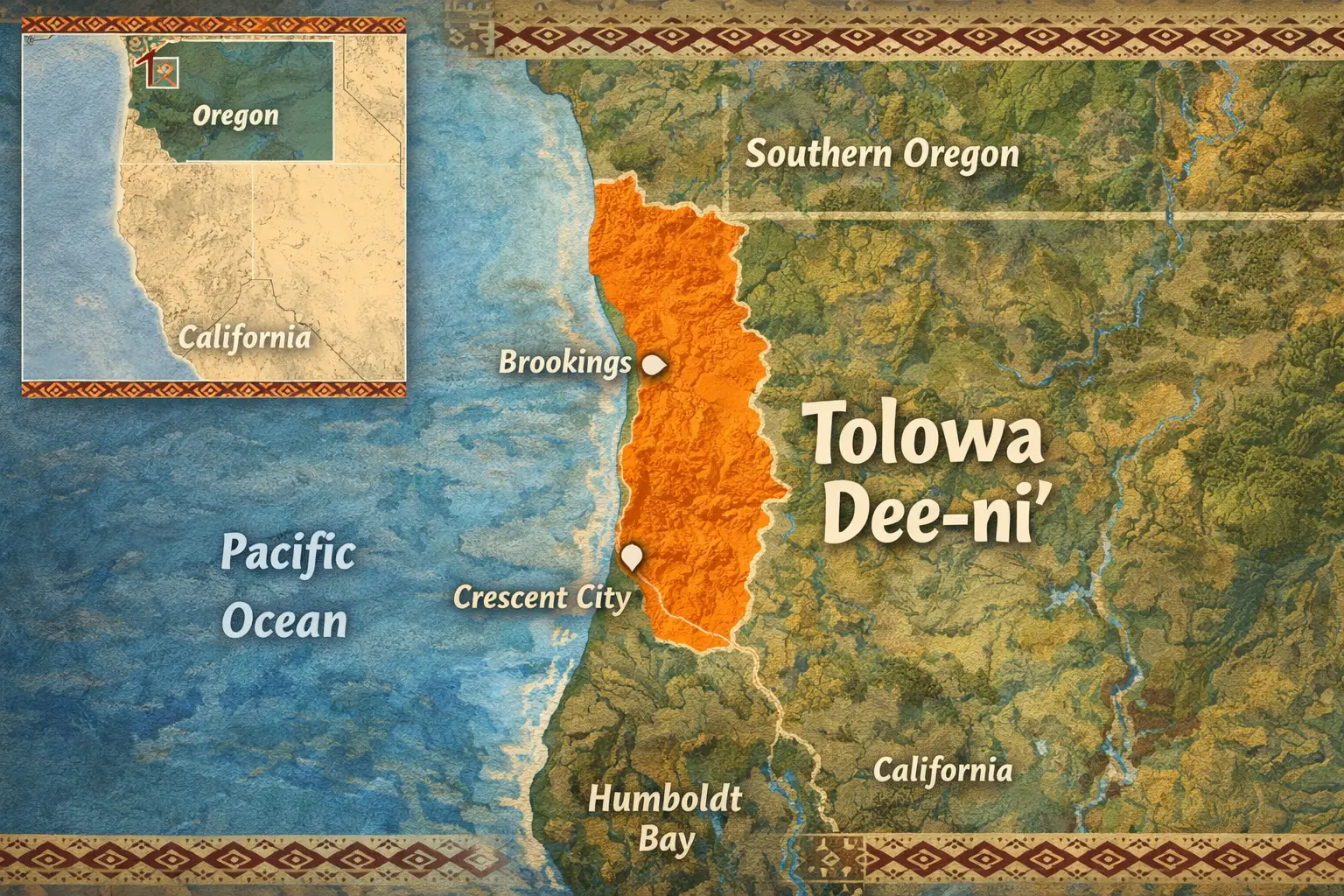
On the Pacific coast of northern California and southern Oregon, the Tolowa Dee-ni’ language is rising again.
Once nearly silenced by colonisation and cultural suppression, it is now at the heart of a powerful revival. For the Tolowa Dee-ni’ people, language carries identity, history, and connection to their land.
Today, communities, elders, and younger generations are working together to bring Tolowa Dee-ni’ back to life.
Importance of language preservation in indigenous cultures
For many Indigenous communities, language is far more than a tool for communication. It carries history, identity, and generations of cultural knowledge.
Stories, traditions, spiritual beliefs, and ecological wisdom are often embedded directly within the language itself, meaning that when a language disappears, a unique way of understanding the world can disappear with it.
Ultimately, protecting Indigenous languages is not only about saving words. It is about safeguarding cultures, knowledge systems, and the diversity of human expression.
Historical Context
The story of Tolowa Dee-ni’ is deeply connected to the history of the Pacific Northwest coast.
For centuries, the language carried the traditions, knowledge, and worldview of the Tolowa Dee-ni’ people.
However, colonisation and forced cultural change placed enormous pressure on both the language and the community.
Origins of the Tolowa Dee-ni’ language
Tolowa Dee-ni’ has been spoken along the Pacific coast for generations, forming a central part of everyday life, storytelling, and cultural identity.
- The language belongs to the Athabaskan (Na-Dene) language family, which includes several Indigenous languages across North America.
- It developed within coastal communities in what is now northern California and southern Oregon.
- Traditionally, it was passed down orally through families, ceremonies, and community life.
- Storytelling, songs, and cultural teachings were key ways the language was preserved.
| Aspect | Details |
| Language Family | Athabaskan (Na-Dene) |
| Traditional Region | Northern California & Southern Oregon |
| Transmission | Oral tradition through families and elders |
| Cultural Role | Storytelling, ceremonies, and daily communication |
Impact of colonisation on the language and culture
Colonisation dramatically disrupted Tolowa Dee-ni’ life and threatened the survival of the language.
- European settlement in the 19th century led to violence, displacement, and loss of land.
- Indigenous communities were forced into mission systems, reservations, and boarding schools.
- Many children were punished for speaking their native language, accelerating language loss.
- Cultural practices and ceremonies tied to the language were also suppressed.
These policies did not just affect communication. They disrupted the cultural systems that sustained the language for generations.
Decline in speakers and the effects on the community
As the pressures of colonisation continued, the number of fluent Tolowa Dee-ni’ speakers declined.
- English became dominant in schools, government, and public life.
- Younger generations often grew up without learning the language at home.
- As elder speakers passed away, the risk of losing the language entirely increased.
| Period | Key Changes |
| Pre-colonial era | Tolowa Dee-ni’ widely spoken in daily life |
| Late 1800s–1900s | Language suppression through colonial policies |
| Late 20th century | Sharp decline in fluent speakers |
Cultural Significance of Tolowa Dee-ni’
For the Tolowa Dee-ni’ people, language is more than words. It carries identity, traditions, and a deep connection to ancestors and land.
Each phrase, story, and expression reflects generations of cultural knowledge and community values.
Preserving the language helps ensure that these traditions continue to live on.
Connection between language and identity
Language is a powerful marker of identity within Indigenous communities. For Tolowa Dee-ni’ people, speaking the language strengthens a sense of belonging and cultural pride.
- The language connects individuals directly to their heritage and ancestors.
- It reinforces community bonds and shared cultural identity.
- Many cultural concepts and expressions cannot be fully translated into English.
- Learning the language helps younger generations reconnect with their roots.
Role of storytelling and oral traditions
Storytelling has long been one of the most important ways the Tolowa Dee-ni’ culture is passed down.
- Traditional stories teach history, values, and lessons about the natural world.
- Elders play a vital role in sharing stories and preserving cultural memory.
- Oral traditions help maintain language structure, vocabulary, and pronunciation.
- Stories often include spiritual teachings and historical knowledge.
These narratives are not just entertainment. They are a living archive of the community’s history and worldview.
Language as a vessel for cultural knowledge and practices
Many aspects of Tolowa Dee-ni’ culture are closely tied to the language itself.
- Words and phrases describe local landscapes, plants, and animals in ways unique to the culture.
- Ceremonies, songs, and traditional practices often rely on specific linguistic expressions.
- Cultural knowledge, such as ecological understanding and traditional skills, is embedded in the language.
- Using the language helps maintain spiritual and ceremonial traditions.
Current Status of Tolowa Dee-ni’
Today, Tolowa Dee-ni’ is considered a critically endangered language, but it is also part of an active revitalisation movement.
Community members, educators, and language learners are working together to rebuild knowledge of the language and bring it back into everyday life.
While the number of fluent speakers remains small, interest in learning the language is growing.
Number of speakers today
The number of fluent Tolowa Dee-ni’ speakers is limited, largely due to historical suppression and generational language loss.
- Only a small number of fluent speakers remain, many of whom are elders.
- Linguists and community organisations have documented the language to support revitalisation efforts.
- New learners, including children and young adults, are beginning to relearn the language through classes and programmes.
| Category | Approximate Situation |
| Fluent speakers | Very small number, mostly elders |
| Semi-speakers/learners | Growing group of younger learners |
| Language status | Critically endangered |
Demographics of the speaker community
The Tolowa Dee-ni’ language community is spread across several tribal and regional groups.
- The language is primarily associated with the Tolowa Dee-ni’ Nation in northern California.
- Some speakers and learners also live in southern Oregon and the surrounding regions.
- Elder speakers play a key role as language teachers and cultural knowledge holders.
- Younger generations are increasingly participating in language classes, cultural camps, and community programmes.
Challenges faced in language revitalisation efforts
Reviving an endangered language presents a number of challenges, particularly when the number of fluent speakers is small.
- Limited number of fluent speakers available to teach the language.
- Historical trauma and language suppression that disrupted transmission between generations.
- Lack of widespread teaching resources and curriculum materials.
- Competing pressures from dominant languages like English in education and daily life.
| Challenge | Impact |
| Few fluent speakers | Harder to pass on natural pronunciation and fluency |
| Historical disruption | Generational gap in language transmission |
| Limited resources | Fewer textbooks and structured learning materials |
| Dominance of English | Reduced daily use of the language |
Language Revitalisation Initiatives
Despite the challenges facing Tolowa Dee-ni’, revitalisation efforts are gaining momentum.
Community members, educators, and cultural leaders are actively working to rebuild the language through teaching programmes, cultural initiatives, and modern technology.
These efforts aim not only to preserve the language but to make it a living part of everyday community life again.
Community-led programmes
Many revitalisation initiatives are driven directly by the Tolowa Dee-ni’ community, ensuring that language learning remains culturally grounded.
- Tribal organisations run language classes, cultural workshops, and immersion activities.
- Elders share knowledge through storytelling sessions, ceremonies, and community gatherings.
- Language camps and cultural events provide opportunities for younger generations to learn in traditional contexts.
- Community-led documentation projects help record vocabulary, pronunciation, and traditional stories.
| Initiative Type | Purpose |
| Language classes | Teach basic vocabulary and grammar |
| Cultural gatherings | Use the language in traditional settings |
| Language camps | Encourage youth participation |
| Documentation projects | Preserve knowledge from fluent speakers |
Educational efforts in schools and local organisations
Education plays a key role in rebuilding the number of Tolowa Dee-ni’ speakers.
- Some schools and community programmes now offer introductory language courses.
- Educational materials are being developed to help students learn the language in structured ways.
- Tribal organisations collaborate with linguists and educators to create teaching resources.
- Youth-focused programmes help integrate the language into cultural education and community identity.
Use of technology and social media in language learning
Technology is becoming an important tool for revitalising endangered languages like Tolowa Dee-ni’.
- Digital dictionaries and recordings help preserve pronunciation and vocabulary.
- Social media platforms allow communities to share phrases, lessons, and cultural content.
- Online videos and language apps provide accessible learning tools for younger generations.
- Digital archives help protect stories, songs, and oral histories for the future.
| Technology Tool | How It Helps |
| Digital dictionaries | Easy access to vocabulary |
| Audio recordings | Preserve authentic pronunciation |
| Social media | Share language with wider audiences |
| Online lessons | Support independent learning |
The Role of Elders and Knowledge Keepers
Elders and knowledge keepers play a central role in preserving and revitalising the Tolowa Dee-ni’ language.
As some of the last fluent speakers, they carry generations of cultural knowledge, stories, and traditions.
Their guidance ensures that the language is not only learned but understood within its full cultural and historical context.
Importance of elders in teaching and preserving the language
Elders are often the most fluent speakers and serve as the foundation of language revitalisation efforts.
- They teach pronunciation, vocabulary, and traditional expressions that may not exist in written records.
- Elders share stories, songs, and cultural teachings that help learners understand the language’s deeper meaning.
- Their involvement ensures that language learning remains authentic and culturally rooted.
- Many community programmes rely on elders as mentors, teachers, and advisors.
Intergenerational transmission of knowledge
For a language to survive, it must be passed from one generation to the next. Intergenerational learning is therefore essential.
- Elders work with younger learners through classes, storytelling, and cultural activities.
- Families are encouraged to use the language at home and during community events.
- Language programmes often pair elders with youth learners for mentorship and conversation practice.
- This process helps rebuild the natural transmission of language within families and communities.
Community events and gatherings that promote language use
Community gatherings provide important opportunities for the language to be spoken in real-life settings.
- Cultural festivals and tribal events encourage public use of Tolowa Dee-ni’.
- Ceremonies and storytelling gatherings help keep oral traditions alive.
- Language camps and workshops allow participants to practise speaking in immersive environments.
- These events strengthen both community identity and language confidence.
| Event Type | Purpose |
| Cultural festivals | Celebrate heritage and language |
| Storytelling gatherings | Share traditional narratives |
| Language camps | Immersive learning experiences |
| Community workshops | Encourage everyday language use |
Challenges and Obstacles
Reviving a language that has faced generations of decline is never simple.
While enthusiasm for Tolowa Dee-ni’ is growing, revitalisation efforts still face several obstacles.
Social pressures, limited resources, and the realities of modern life can all make it difficult to rebuild everyday use of the language.
Societal attitudes towards indigenous languages
For many Indigenous communities, historical attitudes toward native languages created long-lasting challenges.
- For decades, Indigenous languages were often discouraged or suppressed in schools and public life.
- Some community members grew up believing English was the only language linked to opportunity or education.
- These attitudes created a break in language transmission between generations.
- Revitalisation efforts today aim to rebuild pride, visibility, and respect for Indigenous languages.
| Issue | Impact |
| Historical stigma | Reduced confidence in using the language publicly |
| Cultural suppression | Loss of traditions linked to language |
| Generational gaps | Fewer fluent speakers passing the language on |
Funding and resource limitations
Language revitalisation programmes require long-term investment, which can be difficult to secure.
- Many community initiatives operate with limited funding and staff.
- Developing curriculum materials, dictionaries, and recordings can be expensive.
- Programmes often rely heavily on volunteers, elders, and small grants.
- Sustainable funding is needed to support teachers, language camps, and digital resources.
| Resource Need | Why It Matters |
| Teaching materials | Help structure language learning |
| Trained language teachers | Support long-term education |
| Digital resources | Preserve and share language knowledge |
| Funding support | Ensure programmes continue over time |
Balancing modernity with traditional practices
Another challenge is integrating the language into modern life while respecting traditional cultural practices.
- Younger generations often live in English-dominant environments, such as schools and workplaces.
- The language must adapt to modern topics and technology while maintaining traditional meaning.
- Revitalisation programmes must balance cultural authenticity with practical language use.
- Creating spaces where the language can be used in everyday conversation is essential.
| Challenge | Example |
| Modern vocabulary | Words for technology and contemporary life |
| Limited daily use | Few environments where the language is spoken regularly |
| Cultural balance | Preserving tradition while adapting to modern realities |
Future Prospects for Tolowa Dee-ni’
Although Tolowa Dee-ni’ faces challenges, the future of the language is shaped by growing community commitment and renewed cultural pride.
Revitalisation efforts are increasingly focused on building a new generation of speakers, strengthening partnerships, and creating spaces where the language can thrive in everyday life.
Vision for the next generation of speakers
A key goal of revitalisation efforts is to ensure that younger generations grow up with access to the language.
- Expanding language education programmes for children and teenagers.
- Encouraging families to use Tolowa Dee-ni’ at home and in daily conversations.
- Developing learning materials and resources tailored to young learners.
- Creating immersive environments where the language can be spoken naturally and regularly.
Potential partnerships and collaborations
Collaboration with external organisations can strengthen revitalisation initiatives.
- Partnerships with universities and linguists can support language documentation and research.
- Cultural organisations can help develop educational resources and teaching materials.
- Government programmes and grants may provide funding for language revitalisation projects.
- Digital platforms can help share the language with wider audiences and learners.
The role of youth in sustaining the language
Young people are central to the long-term survival of Tolowa Dee-ni’.
- Youth participation helps transform the language from a heritage subject into a living language.
- Young speakers can use the language in music, media, and digital platforms.
- Schools and community programmes encourage active use of the language among younger generations.
- Youth-led initiatives can inspire greater awareness and cultural pride.
| Youth Contribution | Example |
| Language learners | Attending classes and language camps |
| Cultural ambassadors | Promoting the language in communities |
| Digital creators | Sharing language content online |
Tolowa Dee-ni Language FAQs
What is the Tolowa Dee-ni’ language?
Tolowa Dee-ni’ is an Indigenous language belonging to the Athabaskan language family. It has traditionally been spoken by the Tolowa Dee-ni’ people along the Pacific coast of northern California and southern Oregon and is closely tied to the community’s cultural traditions, identity, and history.
Why is Tolowa Dee-ni’ considered endangered?
The language became endangered due to colonisation, forced assimilation policies, and the suppression of Indigenous languages in schools and public life. These factors disrupted the transmission of the language between generations, leading to a sharp decline in fluent speakers.
How many people speak Tolowa Dee-ni’ today?
Today, only a small number of fluent speakers remain, many of whom are elders. However, language revitalisation programmes are helping new learners, particularly younger generations, begin to study and use Tolowa Dee-ni’ again.
What efforts are being made to revitalise the language?
Community-led initiatives include language classes, cultural workshops, language camps, and the documentation of vocabulary and stories. Schools, tribal organisations, and linguists are also working together to develop educational resources and digital tools that support learning.
How can younger generations help preserve Tolowa Dee-ni’?
Young people play a crucial role in the language’s future. By learning and using Tolowa Dee-ni’, participating in cultural programmes, and sharing the language through media, education, and community events, they help ensure the language continues to grow and survive.