
|
Getting your Trinity Audio player ready...
|
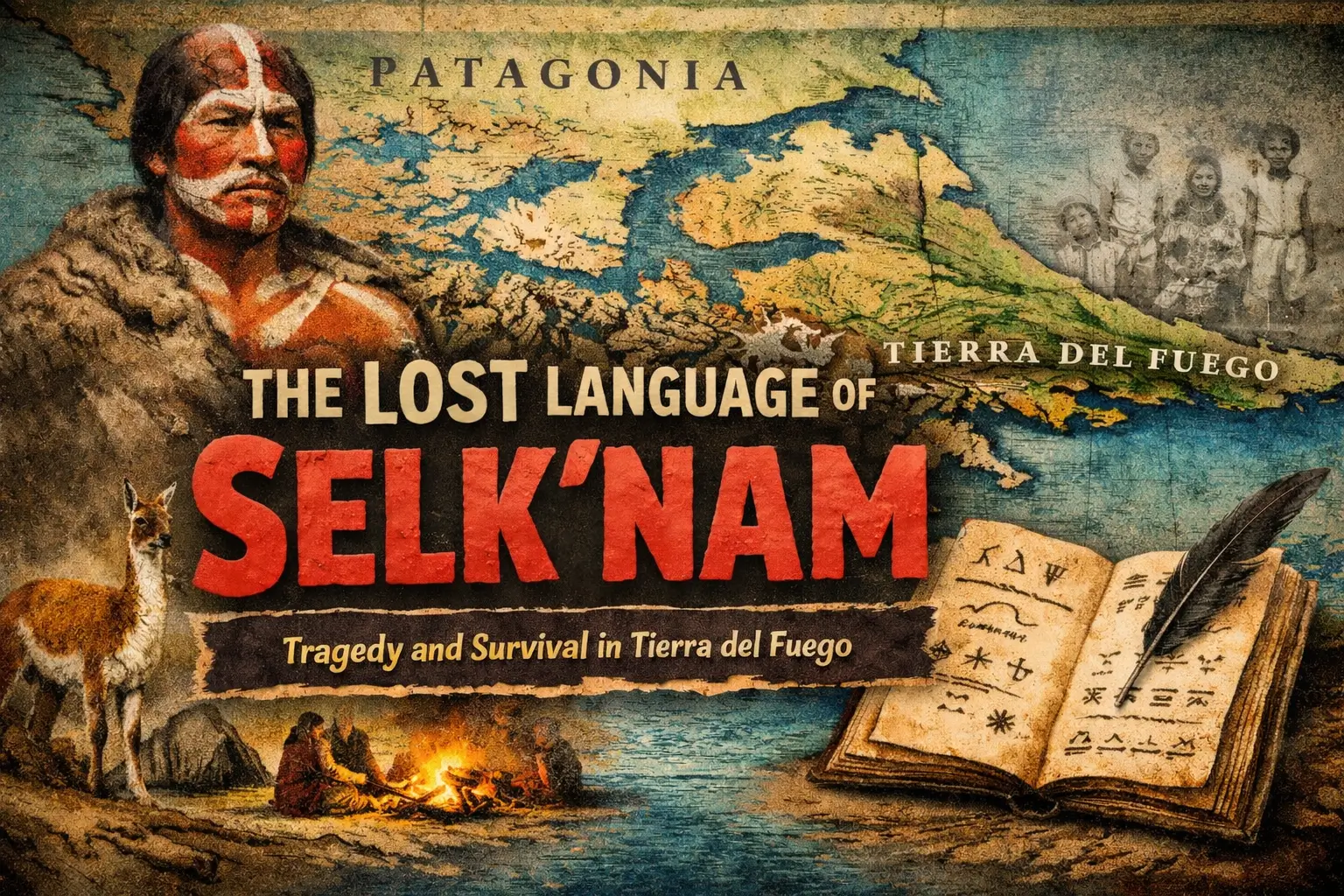
TL;DR: The Selk’nam language was once spoken by the Selk’nam people of Tierra del Fuego in Patagonia, where it formed an essential part of their culture, identity, and oral traditions.
Selk’nam was once spoken across the windswept plains of southern Patagonia by the Selk’nam people of Tierra del Fuego.
Following the arrival of European settlers in the late 19th century, violence, displacement, and disease devastated the Selk’nam population. As communities disappeared, so did their language.
Selk’nam is considered extinct as a spoken language, but its legacy survives through historical records and the cultural revival efforts of Selk’nam descendants determined to reconnect with their heritage.
Selk’nam people and their historical significance in Patagonia
The Selk’nam people were one of the main Indigenous groups of Tierra del Fuego in southern Patagonia. For thousands of years, they lived as nomadic hunter-gatherers, relying on guanaco hunting and deep knowledge of the region’s harsh environment to survive.
However, colonisation in the late 19th century brought violence, land loss, and disease that devastated the Selk’nam population.
Despite this history, the Selk’nam remain an important part of Patagonia’s Indigenous legacy and cultural history.
Selk’nam language and its status as a lost language
Selk’nam was the traditional language of the Selk’nam people of Tierra del Fuego in southern Patagonia.
It belonged to the Chonan language family, which included several now-extinct Indigenous languages once spoken across parts of southern South America.
By the mid-20th century, Selk’nam had effectively disappeared as a living language.
Today, it is considered extinct, surviving mainly through linguistic records, historical documentation, and the cultural revival efforts of Selk’nam descendants.
Historical Context
To understand the Selk’nam language, it is important to look at the history of the people who spoke it.
For thousands of years, the Selk’nam lived across the island of Tierra del Fuego in southern Patagonia, developing a culture and way of life closely tied to the land.
However, the arrival of European settlers in the 19th century brought profound changes that led to the decline of both the Selk’nam population and their language.
The Selk’nam tribe and their way of life
The Selk’nam were traditionally nomadic hunter-gatherers who moved across the open plains of Tierra del Fuego.
Their survival depended largely on hunting guanaco, a wild relative of the llama, as well as gathering plants and other natural resources.
One of the most well-known traditions was the Hain ceremony, an initiation ritual that marked the transition from youth to adulthood and reinforced social values within the tribe.
The impact of European colonisation on the Selk’nam people
The arrival of European explorers, missionaries, and sheep ranchers in the late 19th century dramatically changed life in Tierra del Fuego.
Large areas of land were taken for sheep farming, which disrupted the Selk’nam’s traditional hunting grounds.
At the same time, diseases introduced by Europeans spread quickly among the Indigenous population, causing further devastation.
The decline of the Selk’nam population and language
As the Selk’nam population declined, so did the use of their language.
Communities were broken apart, and younger generations were increasingly exposed to Spanish rather than their ancestral tongue.
Today, it survives only in linguistic records and historical accounts, serving as a reminder of a culture that once thrived in the far south of the Americas.
The Selk’nam Language
Like many Indigenous languages of South America, Selk’nam carried far more than simple communication.
It reflected the Selk’nam people’s relationship with their environment, their social structure, and their spiritual beliefs.
Although the language is now extinct, linguistic research and historical documentation provide valuable insights into its structure and distinctive characteristics.
Description of the Selk’nam language structure and characteristics
Selk’nam belonged to the Chonan language family, a group of Indigenous languages once spoken across southern Patagonia and Tierra del Fuego.
The language was primarily passed down through oral tradition rather than written texts.
Like many Indigenous languages, it relied heavily on context and oral expression, allowing speakers to convey detailed meanings through subtle changes in pronunciation and word order.
Comparison with other indigenous languages in the region
Selk’nam was part of the Chonan language family, a group of Indigenous languages once spoken across southern Patagonia.
While it shared connections with neighbouring languages, it also developed its own dentity shaped by the culture and environment of the Selk’nam people.
- Related to other Chonan languages: Selk’nam had linguistic ties to languages such as Tehuelche and Haush. Spoken by nearby Indigenous groups in Argentina and Chile.
- Shared linguistic roots: These languages showed similarities in grammar structures and certain vocabulary. Suggesting long-standing cultural and historical connections.
- Distinct development over time: Despite these similarities, each language evolved differently as communities adapted to their own environments and traditions.
Unique linguistic features and vocabular
Selk’nam vocabulary reflected the daily realities of life in the harsh landscapes of Tierra del Fuego.
Many words were closely tied to the natural world and the cultural practices of the Selk’nam people.
- Nature-based vocabulary: The language included many terms describing animals, weather patterns, landscapes, and hunting practices essential for survival.
- Spiritual and cultural terms: Words connected to mythology, rituals, and ceremonies played an important role in expressing Selk’nam beliefs and traditions.
- Insights into Selk’nam worldview: Even the limited vocabulary records that survive today offer valuable clues about how the Selk’nam understood their environment and cultural identity.
Cultural Significance of the Language
For the Selk’nam people, language was more than a way to communicate. It carried knowledge, traditions, and beliefs that shaped community life.
Through everyday conversation, stories, and ceremonies, the language helped preserve cultural identity and pass wisdom from one generation to the next.
Role of language in Selk’nam identity and culture
Language played a central role in how the Selk’nam understood themselves and their place in the world.
- A marker of cultural identity: Speaking Selk’nam connected individuals to their community, heritage, and ancestral land.
- Transmission of knowledge: The language carried practical knowledge about hunting, survival, and living in the Patagonian environment.
- Strengthening community bonds: Shared language helped reinforce social relationships and collective traditions.
Connection between language, storytelling, and oral traditions
Storytelling was one of the most important ways Selk’nam culture and knowledge were preserved.
- Oral storytelling traditions: Myths, legends, and historical stories were passed down verbally across generations.
- Teaching values and beliefs: Stories often explained the origins of the world, moral lessons, and cultural rules.
- Preserving history: Without written records, storytelling helped keep the Selk’nam’s cultural memory alive.
The importance of rituals and ceremonies in preserving language
Ceremonies and rituals played a key role in maintaining both cultural practices and the language itself.
- Cultural ceremonies: Events such as the Hain initiation ceremony brought communities together and reinforced traditions.
- Use of ceremonial language: Rituals often included specific words, chants, or expressions tied to spiritual beliefs.
- Passing traditions to younger generations:Through participation in ceremonies, younger Selk’nam learned cultural knowledge and language from elders.
The Decline of the Selk’nam Language
The disappearance of the Selk’nam language did not happen suddenly.
It was the result of a series of historical events that dramatically affected the Selk’nam people and their way of life.
As communities were disrupted and populations declined, the language gradually faded from everyday use.
Factors contributing to the language’s extinction
Several factors played a role in the decline of the Selk’nam language, particularly during the late 19th and early 20th centuries.
- Population decline: Violence, displacement, and introduced diseases greatly reduced the Selk’nam population.
- Loss of traditional lands: The expansion of sheep ranching in Tierra del Fuego disrupted hunting grounds and traditional ways of life.
- Breakdown of communities: As families and groups were separated, fewer opportunities remained for the language to be spoken and passed on.
The role of government policies and societal changes
Government policies and social pressures also contributed to the loss of the language.
- Cultural assimilation: Indigenous people were often encouraged or forced to adopt Spanish and abandon their native languages.
- Mission settlements: Many Selk’nam were moved to missions where Spanish became the dominant language.
- Changing social structures: As traditional lifestyles disappeared, younger generations increasingly used Spanish in daily life.
Personal stories of the last speakers and their experiences
By the early 20th century, only a small number of fluent Selk’nam speakers remained.
- Elders as language keepers: The final speakers carried valuable knowledge of vocabulary, traditions, and stories.
- Documentation by researchers: Linguists and anthropologists recorded parts of the language from these speakers before it disappeared.
- A fading voice of Patagonia: The experiences of these last speakers highlight the human side of language loss and the cultural heritage that disappeared with them.
Efforts for Revitalisation
Although Selk’nam is considered an extinct language, efforts to recover and preserve elements of it have emerged in recent years.
Descendants of the Selk’nam people, along with researchers and cultural organisations, are working to reconnect with the language and protect the heritage it represents.
Current initiatives to revive the Selk’nam language
Several initiatives focus on documenting and reconstructing what remains of the language.
- Linguistic reconstruction: Researchers analyse historical records, field notes, and early recordings to better understand Selk’nam vocabulary and grammar.
- Cultural preservation projects: Museums and academic institutions help archive documents and materials related to the language.
- Digital resources: Some projects are beginning to digitise linguistic records to make them more accessible for study and cultural learning.
Involvement of indigenous communities and linguists
Revitalisation efforts rely on collaboration between Selk’nam descendants and language specialists.
- Community-led cultural revival: Selk’nam descendants are reclaiming traditions and reconnecting with their ancestral identity.
- Academic partnerships: Linguists and anthropologists work with communities to interpret historical linguistic materials.
- Shared knowledge preservation: Collaboration ensures that research supports cultural heritage rather than simply academic study.
Educational programmes and resources available
Education plays an important role in keeping the memory of the language alive.
- Workshops and cultural events: Community programmes sometimes introduce Selk’nam words, traditions, and history.
- Educational materials: Books, research papers, and documentaries help spread awareness about the language.
- Public awareness initiatives: Schools, museums, and cultural institutions increasingly highlight the history of the Selk’nam people and their language.
Lessons from the Selk’nam Experience
The story of the Selk’nam language offers important lessons about the fragile nature of cultural heritage.
When communities lose their land, traditions, and social structures, their languages are often among the first things to disappear.
What the Selk’nam language loss teaches us about cultural preservation
The disappearance of Selk’nam shows how closely language is tied to community survival.
- Language and culture are deeply connected: When cultural practices decline, the language that expresses them often fades as well.
- Historical events matter: Colonisation, displacement, and social change can rapidly weaken Indigenous languages.
- Documentation is critical: Recording languages through research, archives, and education helps preserve knowledge for future generations.
Strategies for other communities facing similar challenges
Communities working to protect their languages can learn from both the loss and preservation efforts surrounding Selk’nam.
- Community-led revitalisation: Successful language revival often begins within the community itself.
- Education and teaching programmes: Introducing Indigenous languages in schools and cultural programmes helps younger generations learn them.
- Use of modern technology: Digital dictionaries, recordings, and online resources can make endangered languages more accessible and easier to preserve.
Future of the Selk’nam Language
Although Selk’nam is no longer spoken as a living language, interest in the culture and history of the Selk’nam people has grown in recent years
Scholars, cultural organisations, and Selk’nam descendants are increasingly working to preserve what remains of the language and ensure that its heritage is not forgotten.
Potential for language revival and cultural resurgence
While a full revival of Selk’nam is challenging due to the lack of fluent speakers, there are still meaningful ways to reconnect with the language.
- Reconstruction from historical records: Linguists continue to study old field notes, dictionaries, and recordings to better understand the language.
- Cultural revitalisation movements: Selk’nam descendants are reclaiming traditional practices, stories, and identities connected to their ancestors.
- Growing academic interest: Universities and research institutions are documenting the language to preserve it for future study.
The role of younger generations in keeping the language alive
Younger generations often play a key role in cultural revival.
- Learning about ancestral heritage: Many Selk’nam descendants are exploring their history and cultural traditions.
- Using modern tools for preservation: Digital archives, online resources, and educational content can help younger people access and learn about the language.
- Community engagement: Cultural events, workshops, and storytelling initiatives help keep Selk’nam heritage visible and meaningful.
Vision for the future of the Selk’nam language and culture
The future of Selk’nam may not mean returning to widespread everyday use, but its cultural significance can still grow.
- Preserving knowledge and history: Continued research ensures the language remains part of the historical record.
- Strengthening cultural identity: Reviving traditions connected to the language can help communities reconnect with their roots.
- Raising global awareness: Sharing the story of Selk’nam highlights the importance of protecting Indigenous languages around the world.
Selk’nam Language FAQs
What was the Selk’nam language?
Selk’nam was an Indigenous language spoken by the Selk’nam people of Tierra del Fuego in southern Patagonia. It belonged to the Chonan language family and was mainly passed down through oral traditions.
Why did the Selk’nam language become extinct?
The language declined after European colonisation in the late 19th century. Violence, disease, land loss, and displacement reduced the Selk’nam population and interrupted the transmission of the language to younger generations.
Are there any records of the Selk’nam language?
Yes. Parts of the language survive in linguistic field notes, vocabulary lists, and historical documentation recorded by researchers and anthropologists.
Can the Selk’nam language be revived?
A full revival is difficult because there are no fluent speakers today. However, researchers and Selk’nam descendants are studying historical materials to reconstruct parts of the language.
Why is the Selk’nam language important today?
The language represents an important part of Patagonia’s Indigenous heritage. Preserving its records helps raise awareness about language loss and the importance of protecting Indigenous cultures.