|
Getting your Trinity Audio player ready...
|
TL;DR: Separable verbs feel confusing at first, but they’re not random, just misunderstood. They follow clear patterns: a base verb + a prefix that moves depending on the sentence. In main clauses, the verb splits. In others, it stays together. Once you understand when and why, everything clicks. The real shift is this: stop memorising lists and start recognising patterns. Prefixes carry meaning, and sentences only make sense once you hear or see the full verb, often at the end.
Separable verbs are one of the most confusing parts of German. Not because they’re random, but because they’re often taught badly.
You learn a verb like ankommen, then suddenly the prefix disappears from the end of the sentence, and everything feels wrong.
The good news is that separable verbs follow clear patterns. Once you stop memorising lists and start understanding how prefixes behave, they become predictable and easy to recognise.
The importance of separable verbs in German
Separable verbs are everywhere in German. They’re used to talk about daily routines, movement, plans, and actions. The things you say most often. If you don’t understand them, German quickly feels confusing, even when the German vocabulary is familiar.
Recognising separable verbs is crucial for understanding real spoken German. Miss the prefix at the end of the sentence, and the meaning can fall apart.
Mastering separable verbs isn’t optional. It’s a turning point that makes German feel clearer, more logical, and far easier to use with confidence.
Common challenges learners face when dealing with separable verbs
Separable verbs often trip learners up not because they are rare or advanced, but because they behave differently from English verbs.
Until the patterns become familiar, they can make German sentences feel unpredictable and hard to follow.
Common challenges include:
- Losing track of the prefix when it moves to the end of the sentence
- Not recognising a verb as separable when listening or reading
- Forgetting to separate the verb in main clauses
- Separating the verb when it should stay together
- Confusing separable and inseparable prefixes with similar meanings
- Struggling to recall the full verb when speaking under pressure
Separable German Verbs
Separable verbs are a core feature of German. One of the first places learners feel the language behaving differently from English.
Once you understand what they are and how they work. A lot of German sentence structure suddenly clicks into place.
Definition of German separable verbs
A separable verb is a verb made up of two parts: a base verb and a prefix.
In certain sentence types, that prefix separates from the verb. It moves to the end of the sentence. The key point is that the meaning comes from the whole verb, not the parts in isolation.
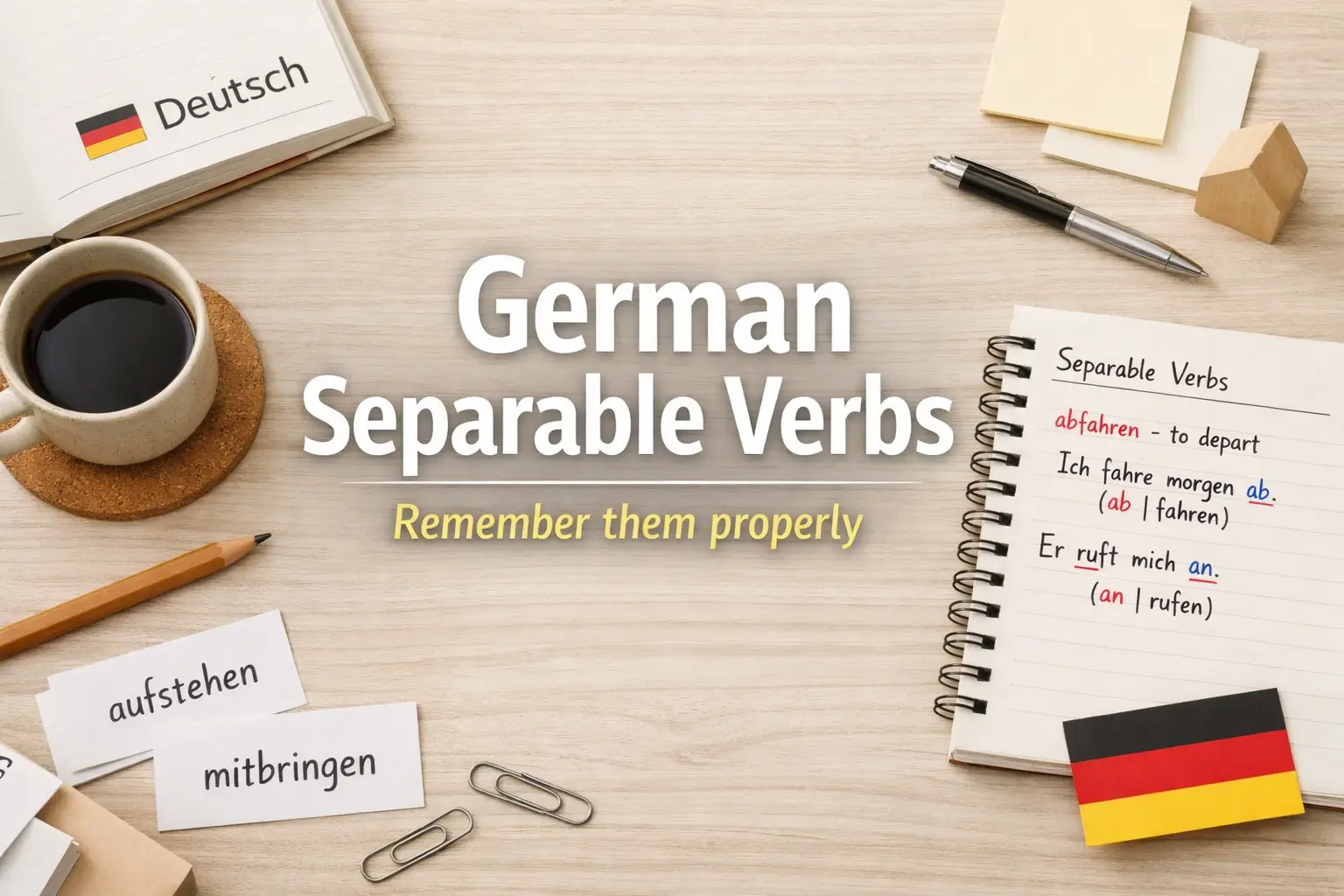
For example, ankommen means to arrive. The verb isn’t just kommen (to come) plus a random extra. The prefix an- changes the meaning in a specific, predictable way.
Explanation of how they function within sentences
In main clauses, the conjugated verb sits in second position, while the prefix moves to the end. This is why German sentences can feel unfinished until the very last word.
Compare:
- Ich komme an.
- Der Zug kommt um acht Uhr an.
In infinitives, modal constructions, and subordinate clauses, the verb stays together:
- Ich möchte ankommen.
- …, weil der Zug spät ankommt.
Understanding when verbs split removes a huge amount of confusion. Especially when reading, listening, and speaking.
Examples of common separable verbs
Many of the most useful everyday verbs in German are separable, which is why they matter so much early on. Examples include:
- aufstehen – to get up
- ankommen – to arrive
- mitbringen – to bring along
- abholen – to pick up
- einschlafen – to fall asleep
The Structure of German Separable Verbs
German separable verbs aren’t random constructions.
They’re built from clear, meaningful parts.
Understanding how those parts fit together makes new verbs easier to recognise, understand, and remember.
Prefix and main verb: how separable verbs are built
Every separable verb has two components: a prefix and a main verb. The main verb carries the core action, while the prefix adds direction, completion, or context.
When combined, they create a new meaning that is often more specific than the base verb alone.
For example, kommen means to come. Add different prefixes, and the meaning shifts:
- ankommen – to arrive
- zurückkommen – to come back
- mitkommen – to come along
How the prefix changes the meaning of the verb
Prefixes are not decorative. They actively shape what the verb means. Many relate to ideas such as movement, starting, stopping, or direction.
This is why learning prefixes as meaningful units is far more effective than memorising entire verbs in isolation.
For instance:
- auf- often suggests opening or starting (aufmachen, aufstehen)
- ab- often implies separation or completion (abholen, abschließen)
- mit- usually indicates doing something together (mitkommen, mitnehmen)
Examples illustrating this structure
Seeing the structure in action makes it stick:
- Ich stehe um sieben Uhr auf.
- Sie holt ihren Bruder ab.
- Kommst du heute mit?
In each case, the verb’s meaning only becomes clear once the prefix appears. Often at the very end of the sentence.
Common Spanish Patterns and Rules
Separable verbs may look unpredictable at first. They follow clear patterns.
Once you know what to look for, they become much easier to spot, conjugate, and use correctly.
Common prefixes used in separable verbs
Many separable verbs are built from a small set of common prefixes.
These prefixes tend to carry consistent meanings. It helps you guess what a verb does even if you’ve never seen it before.
Some of the most frequent separable prefixes include:
- ab- (away, off, completion): abholen, abschalten
- an- (arrival, starting, attachment): ankommen, anfangen
- auf- (up, open, beginning): aufstehen, aufmachen
- aus- (out, completion): ausgehen, auspacken
- ein- (in, into): einsteigen, einkaufen
- mit- (with, along): mitkommen, mitnehmen
- vor- (forward, before): vorstellen, vorbereiten
- zurück- (back): zurückkommen, zurückgehen
Rules for conjugating separable verbs in different tenses
The key rule is simple: only the conjugated part moves. The prefix follows sentence rules.
- Present tense (main clause): verb splits, prefix goes to the end
- Ich fange um neun Uhr an.
- Ich fange um neun Uhr an.
- Past tense (Perfekt): prefix stays attached, ge- goes in between
- Ich habe angefangen.
- Ich habe angefangen.
- Modal verbs: infinitive stays together at the end
- Ich muss früh aufstehen.
- Ich muss früh aufstehen.
- Subordinate clauses: verb does not split
- …, weil ich früh aufstehe.
Tips for identifying separable verbs in sentences
Many learners miss separable verbs simply because they don’t expect the prefix to appear later. These strategies help you spot them instantly:
- Always scan the end of the sentence for a stray prefix
- Ask yourself whether the verb feels “unfinished” without the final word
- Learn prefixes as meaning units, not random syllables
- When listening, mentally “hold space” for a prefix before the sentence ends
Effective Learning Techniques
Separable verbs only stick when you learn them actively.
Passive reading or rote memorisation isn’t enough.
You need techniques that train your brain to recognise, recall, and use them under real conditions.
Utilising flashcards for memorisation
Flashcards work best when they focus on patterns, not isolated verbs.
Instead of memorising ankommen on its own, pair the verb with a full sentence that shows the separation clearly.
For example, a stronger flashcard might show:
- Front: Ich komme um acht Uhr ___.
- Back: an – ankommen (to arrive)
This trains you to expect the prefix at the end and recall it automatically.
Digital flashcards with spaced repetition are especially effective for locking these patterns into long-term memory.
Incorporating visual aids and charts
Visual structure helps make separable verbs feel logical rather than chaotic. Charts that group verbs by prefix allow you to see how meaning shifts across different verbs.
For example, a single chart for auf- verbs (aufstehen, aufmachen, aufhören) reinforces the shared idea of starting or opening.
Colour-coding prefixes and base verbs can also help your brain process the split visually, which improves recall when reading or speaking.
Engaging with multimedia resources (videos, apps, etc.)
Hearing separable verbs used naturally is essential. Videos, podcasts, and language apps expose you to verbs splitting in real time, which builds listening confidence and pattern recognition.
Pay close attention to how native speakers pause slightly before the prefix at the end of a sentence. That rhythm helps signal that a separable verb is coming.
Combining audio, text, and context makes separable verbs feel familiar instead of surprising, which is exactly what you want.
Mnemonic German Devices for Retention
Separable verbs are much easier to remember when you stop treating them as abstract grammar and start turning them into images, stories, or mental shortcuts.
Mnemonics give your brain something concrete to grab onto. This is exactly what helps these verbs stick.
How to create memorable associations with verbs
Focus first on the prefix, because that’s the part learners usually forget.
Many prefixes express direction, movement, or change, so turn that idea into a vivid mental picture. The clearer and more exaggerated the image, the stronger the memory.
For example, for aufstehen (to get up), imagine the word auf physically lifting itself and jumping to the end of the sentence as you stand up. Linking motion to meaning makes recall far easier.
Examples of German mnemonic devices tailored to separable verbs
Here are a few simple, effective examples:
- Ankommen: picture arriving at a destination and finally reaching the sign marked an at the end
- Mitnehmen: imagine dragging someone (mit) along while carrying something
- Abholen: visualise pulling something away (ab) from a place
You can also use mini-stories. Imagine the sentence unfolding and only “making sense”. Once the prefix appears at the end.
Encouragement to develop personal mnemonics
The best mnemonics are the ones you invent. If an image feels silly, emotional, or oddly specific, it’s probably working. Don’t worry about elegance. Memorability matters far more.
But early on, personal mnemonics are a powerful tool for turning separable verbs from a constant obstacle into something you handle automatically.
Real-Life Application of German Separable Verbs
Separable verbs only become truly comfortable when you start using them in real situations.
The goal is not perfect German grammar on paper. But confident recognition and use in everyday German.
Strategies for using German separable verbs in everyday conversation
Start small and focus on high-frequency verbs you genuinely need.
Build short, repeatable sentences around daily routines, such as getting up, going out, or meeting people. Reusing the same structures helps your brain internalise where the prefix belongs.
Speaking slowly at first also helps. Giving yourself time to wait for the prefix at the end of the sentence prevents the common habit of dropping it altogether.
The role of immersion in mastering separable verbs
Immersion trains your ear to expect separable verbs naturally. Watching German TV shows, YouTube videos, or listening to podcasts exposes you to verb splitting in real time, which strengthens pattern recognition far faster than textbooks alone.
Reading also plays a key role. When you see a sentence that only makes sense once you reach the final word, you’re experiencing exactly how German separable verbs function in real German.
Joining language exchange groups or classes for practice
Language exchanges and classes provide safe spaces to practise without pressure. Hearing others make the same mistakes reinforces your own understanding. While feedback from native speakers helps you fine-tune usage.
Regular speaking practice turns separable verbs from something you think about into something you do. That shift is what makes them feel natural, reliable, and easy to use.
Common Mistakes to Avoid
Separable verbs are a common stumbling block. That’s completely normal.
Most mistakes come from predictable patterns. Which means they’re also easy to fix once you know what to watch out for.
Highlighting frequent errors learners make with separable verbs
Separable verbs tend to cause the same problems again and again. Knowing these ahead of time makes them much easier to spot and fix.
- Forgetting the prefix entirely, especially when speaking
- Starting the sentence correctly but leaving the verb unfinished
- Splitting the verb when it should stay together (infinitives and subordinate clauses)
- Missing the prefix at the end when listening or reading
- Relying on English word order and assuming the meaning is complete too early
Tips for overcoming these mistakes
These issues are fixable with a small shift in how you practise and pay attention to structure.
- Train yourself to expect the prefix at the end of the sentence
- When listening, mentally hold space for the verb until the sentence finishes
- When speaking, slow down slightly and commit to finishing the verb
- Practise full sentences rather than isolated verbs
- Notice when verbs split. When they must stay together
German Separable Verbs FAQs
What are separable verbs in German?
Separable verbs are verbs made up of a base verb and a prefix that can split apart in certain sentence structures. In main clauses, the prefix moves to the end of the sentence, while in infinitives and subordinate clauses, the verb stays together.
How do I know if a German verb is separable?
Many separable verbs use common prefixes such as ab-, an-, auf-, aus-, ein-, or mit-. In sentences, you’ll often notice the prefix appearing at the very end, which signals that the verb is separable.
Do separable verbs split in all tenses?
No. Separable verbs split in main clauses in the present and simple past. In the perfect tense, the prefix stays attached and the ge- is placed between the prefix and the base verb. In subordinate clauses, the verb does not split.
Why does the prefix go to the end of the sentence?
German sentence structure places the conjugated verb in second position in main clauses. With separable verbs, only the main verb moves to that position, leaving the prefix to appear at the end.
How can I practise separable verbs effectively?
The best approach is to practise them in full sentences, not in isolation. Reading, listening to native German content, and speaking helps train your brain to recognise and use separable verbs naturally.