|
Getting your Trinity Audio player ready...
|
TL;DR: English verb tenses help explain when actions happen and how they unfold through time, whether they are completed, ongoing, repeated, or continuing. Understanding the differences between past, present, and future tenses, alongside aspects like simple, continuous, perfect, and perfect continuous, is essential for speaking and writing clearly in English.
English verb tenses can feel overwhelming at first.
One minute you’re talking about the present; the next you’re trying to work out the difference between “I went”, “I’ve gone”, and “I had gone”.
But once you understand how English tenses actually work, everything starts to click into place.
Suddenly, a tiny change to a verb can completely change the meaning of a sentence. It’s one of the biggest reasons English can feel confusing, even for learners who already know a lot of vocabulary.
The importance of verb tenses in English
Verb tenses are one of the most important parts of speaking and understanding English clearly. They help us show when something happens, whether it’s happening now, happened in the past, or will happen in the future. They also help explain duration, routines, finished actions, ongoing situations, and future plans.
Using the correct tense makes your English sound more natural, accurate, and easier for other people to understand.
Even if your vocabulary is strong, incorrect verb tenses can quickly create confusion in conversations, writing, work, travel, and everyday communication.
Get answers like this for your language questions
Your personal AI language tutor — adapts to your native language, your level, and the words that actually trip you up.
Understanding Verb Tenses
Verb tenses are one of the foundations of English. They shape how we talk about the past, describe what’s happening right now, and explain future plans, goals, and possibilities. Without them, conversations would quickly become unclear and confusing.
The good news is that verb tenses follow patterns. Once you start recognising how they work, English becomes much easier to understand and use naturally in everyday situations.
What are verb tenses?
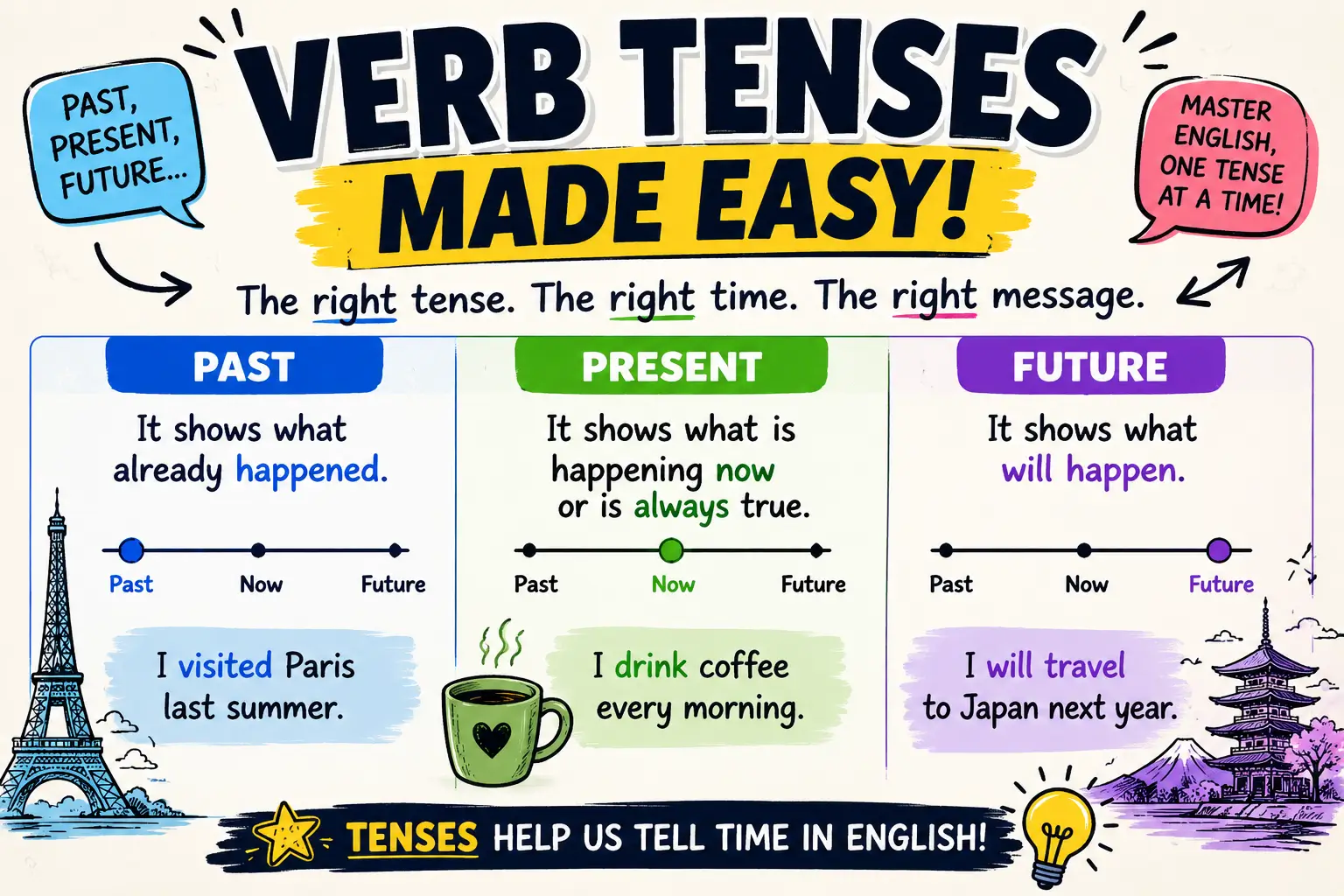
Verb tenses are changes to a verb that show when an action happens. In English, we change verbs to talk about the past, present, and future.
For example:
- “I walk” shows a present action
- “I walked” shows a past action
- “I will walk” shows a future action
These small changes completely change the meaning of a sentence. Even a single word can tell us whether something already happened, is happening now, or has not happened yet.
The role of verb tenses in conveying time and aspect
Verb tenses do more than just show time. They also help explain the nature of an action. This is known as aspect.
For example, English can show whether an action is
- Finished
- Ongoing
- Repeated regularly
- Temporary
- Still continuing
Compare these sentences:
- “I studied English.”
- “I am studying English.”
- “I have been studying English for two years.”
All three sentences talk about studying English, but each one creates a very different meaning.
The three main time frames: past, present, and future
English verb tenses are built around three main time frames:
Past
The past is used for actions or situations that have already happened.
Examples:
- “She visited London last year.”
- “They watched a film yesterday.”
Present
The present is used for actions happening now, regular routines, facts, and general truths.
Examples:
- “I work in a café.”
- “He is talking on the phone.”
Future
The future is used for actions or events that have not happened yet.
Examples:
- “We will travel next month.”
- “She is going to start university soon.”
These three time frames is the first major step towards mastering English verb tenses. Once you know when an action takes place, choosing the correct tense becomes much easier.
The Present Tense
The present tense is one of the most commonly used parts of English. We use it every day to talk about routines, facts, actions happening right now, experiences, habits, and situations that are continuing.
At first, the different present tenses can feel confusing because English has several versions of the “present”. But each one is used in a specific way, and once you understand the patterns, they become much easier to recognise in real conversations.
What is the present simple tense?
The present simple tense is used to talk about routines, habits, facts, and things that are generally true. It is usually the first English tense learners encounter because it appears constantly in everyday communication.
Examples:
- “I work in an office.”
- “She drinks coffee every morning.”
- “The Earth moves around the Sun.”
The structure is usually straightforward:
- Subject + base verb
- For he, she, and it, we normally add -s or -es
Examples:
- “I play football.”
- “He plays football.”
Usage examples and common scenarios
The present simple appears in many everyday situations. It is especially common when talking about:
Daily routines
- “I wake up at 7am.”
- “They go to the gym after work.”
Facts and general truths
- “Water boils at 100°C.”
- “Madrid is the capital of Spain.”
Likes, dislikes, and opinions
- “She loves Italian food.”
- “I don’t like cold weather.”
Timetables and schedules
- “The train leaves at 6pm.”
- “School starts next Monday.”
Even though it is called the “present” simple tense, it is not always about actions happening right now. Instead, it often describes things that are regular, repeated, or generally true.
Present continuous tense: formation and usage
The present continuous tense is used for actions happening right now or around the current moment. It often describes temporary situations or activities that are still in progress.
Examples:
- “I am studying English.”
- “She is watching television.”
- “They are working late tonight.”
The structure is:
- Subject + am/is/are + verb + ing
Examples:
- “I am reading.”
- “He is cooking.”
- “We are learning.”
The present continuous is commonly used for:
Actions happening now
- “The baby is sleeping.”
- “I’m talking to my friend.”
Temporary situations
- “She is living in London for the summer.”
Changing situations
- “Technology is evolving quickly.”
Future arrangements
- “We are meeting them tomorrow.”
This tense helps create a sense of immediacy and movement, which is why it appears so often in spoken English.
Present perfect and present perfect continuous: definitions and examples
These two tenses often confuse learners because they connect the past and the present.
Present Perfect
The present perfect tense is used for actions that happened in the past but still have a connection to the present.
Examples:
- “I have visited Paris.”
- “She has finished her homework.”
- “They have lived here for years.”
The structure is:
- Subject + have/has + past participle
We often use the present perfect when:
- Talking about life experiences
- Describing unfinished time periods
- Discussing actions with present results
Compare:
- “I lost my keys.”
- “I have lost my keys.”
The second sentence suggests the keys are still missing now.
Present Perfect Continuous
The present perfect continuous focuses on actions that started in the past and are still continuing, or have recently stopped but still affect the present.
Examples:
- “I have been studying all day.”
- “She has been working here for five years.”
- “It has been raining.”
The structure is:
- Subject + have/has been + verb + ing
This tense often emphasises duration and ongoing activity rather than completion.
Compare:
- “I have read the book.”
- “I have been reading the book.”
The first focuses on completion. The second focuses on the ongoing process.
The Past Tense
The past tense allows us to talk about things that have already happened. In English, we use different past tenses depending on whether an action was finished, ongoing, repeated, or connected to another event in the past.
This is where many learners start to notice how detailed English can become. A small change in tense can completely change how a story or situation is understood.
What is the past simple tense?
The past simple tense is used for completed actions that happened at a specific point in the past. It is one of the most common tenses in spoken and written English because we constantly use it to talk about experiences, memories, and finished events.
Examples:
- “I visited Spain last year.”
- “She watched a film yesterday.”
- “They arrived late.”
For regular verbs, we usually add -ed:
- “walk” → “walked”
- “play” → “played”
However, English also contains many irregular verbs:
- “go” → “went”
- “see” → “saw”
- “eat” → “ate”
This is why memorising common irregular verbs becomes important as your English improves.
Common uses and examples
The past simple tense appears in many everyday situations. It is commonly used for:
Finished actions
- “I finished my homework.”
- “He called me last night.”
Past habits or routines
- “We played outside every evening.”
- “She walked to school when she was younger.”
Sequences of events
- “I woke up, had breakfast, and left the house.”
Historical facts
- “The company started in 1998.”
- “Shakespeare wrote many famous plays.”
The past simple usually works alongside time expressions such as:
- yesterday
- last week
- in 2020
- two hours ago
- when I was younger
These help make it clear that the action is fully completed.
Past continuous tense: structure and when to use it
The past continuous tense describes actions that were happening at a specific moment in the past. Instead of focusing on a completed action, it focuses on an action in progress.
Examples:
- “I was studying when you called.”
- “They were watching television at midnight.”
- “She was driving home during the storm.”
The structure is:
- Subject + was/were + verb + ing
Examples:
- “He was working.”
- “We were talking.”
The past continuous is often used for:
Actions interrupted by another action
- “I was sleeping when the alarm rang.”
Background information in stories
- “The sun was shining and people were walking along the beach.”
Parallel actions
- “She was cooking while he was cleaning.”
This tense helps create a clearer picture of what was happening during a moment in the past.
Past perfect and past perfect continuous: explanations and examples
These tenses are used when talking about actions that happened before another point in the past.
Past Perfect
The past perfect tense describes an action that was completed before another past action happened.
Examples:
- “I had finished dinner before they arrived.”
- “She had already left when I called.”
The structure is:
- Subject + had + past participle
This tense is useful because it makes the order of events very clear.
Compare:
- “They left when I arrived.”
- “They had left when I arrived.”
The second sentence shows they left before the arrival happened.
Past Perfect Continuous
The past perfect continuous focuses on the duration of an action before another event in the past.
Examples:
- “I had been studying for hours before the exam.”
- “She had been working there for years before she moved.”
The structure is:
- Subject + had been + verb + ing
This tense often highlights:
- Ongoing effort
- Duration
- Repeated activity before another event
Compare:
- “He had worked there before.”
- “He had been working there for years.”
The second sentence places more emphasis on the length and continuation of the action.
Get explanations like this for your English questions
Personalised to your native language and level. Free to start, no card needed.
The Future Tense
The future tense helps us talk about things that have not happened yet. We use it to discuss plans, predictions, goals, promises, expectations, and events that may happen later.
English future tenses can seem complicated at first because there are several different ways to talk about the future. However, each tense focuses on a slightly different idea, such as completed actions, ongoing activities, or future timing.
What is the future simple tense?
The future simple tense is used to talk about future actions, decisions, predictions, and promises. It is most commonly formed using will.
Examples:
- “I will call you later.”
- “She will travel next month.”
- “They will help us.”
The structure is:
- Subject + will + base verb
Examples:
- “I will study.”
- “He will arrive soon.”
In spoken English, will is often shortened:
- “I’ll”
- “She’ll”
- “They’ll”
Usage and examples in everyday conversation
The future simple tense appears constantly in everyday English. It is commonly used for:
Predictions
- “It will rain tomorrow.”
- “You’ll enjoy the film.”
Spontaneous decisions
- “I’ll answer the phone.”
- “We’ll order pizza tonight.”
Promises and offers
- “I’ll help you with your homework.”
- “I won’t tell anyone.”
Future facts
- “The meeting will start at 10am.”
English speakers also commonly use going to when talking about future plans or strong expectations.
Examples:
- “I’m going to start learning Japanese.”
- “Look at those clouds – it’s going to rain.”
Both forms talk about the future, but they are often used in slightly different situations.
Future continuous tense: formation and applications
The future continuous tense describes actions that will be in progress at a specific moment in the future.
Examples:
- “I will be working tomorrow morning.”
- “She will be travelling next week.”
- “They will be waiting for us.”
The structure is:
- Subject + will be + verb + ing
This tense is commonly used for:
Actions in progress in the future
- “This time tomorrow, I’ll be flying to Madrid.”
Polite questions about plans
- “Will you be using the car later?”
Expected future activities
- “We’ll be staying at a hotel near the beach.”
The future continuous often makes future events sound more natural and less direct in conversation.
Future perfect and future perfect continuous: definitions and examples
These tenses focus on actions that will be completed or continuing before a certain point in the future.
Future Perfect
The future perfect tense describes actions that will be completed before a future moment or deadline.
Examples:
- “I will have finished the project by Friday.”
- “She will have left before we arrive.”
The structure is:
- Subject + will have + past participle
This tense is useful when focusing on completion.
Examples:
- “By next year, they will have lived here for a decade.”
- “He will have graduated by then.”
Future Perfect Continuous
The future perfect continuous tense focuses on how long an action will have been continuing before a future point.
Examples:
- “I will have been studying for three hours by midnight.”
- “She will have been working there for ten years next month.”
The structure is:
- Subject + will have been + verb + ing
This tense emphasises duration and ongoing activity leading up to a future moment.
Compare:
- “They will have worked there for years.”
- “They will have been working there for years.”
The second sentence places more emphasis on the continuous nature of the action over time.
The Importance of Aspect
When learning English verb tenses, most people focus on time: past, present, or future. But there’s another important part of English grammar that changes how actions are understood: aspect.
Aspect helps explain the nature of an action. It tells us whether something is completed, ongoing, repeated, temporary, or still continuing over time.
This is one of the reasons English can express very specific meanings with only small changes to a sentence.
What is the concept of aspect in verb tenses?
‘Aspect’ describes how an action unfolds through time rather than simply when it happens.
For example, look at these sentences:
- “I work.”
- “I am working.”
- “I have worked.”
- “I have been working.”
All four sentences relate to the present in some way, but they create completely different meanings.
Aspect helps answer questions like the following:
- Is the action finished?
- Is it still happening?
- Was it temporary or repeated?
- Did it continue over a period of time?
This is why understanding aspects is essential for sounding natural in English.
Distinction between simple, continuous, perfect, and perfect continuous aspects
English uses four main aspects, and each one changes how an action is viewed.
Simple Aspect
The simple aspect focuses on facts, routines, or completed actions without emphasising duration.
Examples:
- “I study English.”
- “She visited London.”
- “They will arrive tomorrow.”
The simple aspect usually focuses on the action itself rather than the process.
Continuous Aspect
The continuous aspect focuses on actions in progress or temporary situations.
Examples:
- “I am studying English.”
- “She was sleeping.”
- “They will be travelling next week.”
This aspect creates a sense of movement and ongoing activity.
Perfect Aspect
The perfect aspect connects one point in time to another. It often focuses on completed actions and their results.
Examples:
- “I have finished my work.”
- “She had left before I arrived.”
- “They will have completed the project by Friday.”
The perfect aspect often highlights completion or experience.
Perfect Continuous Aspect
The perfect continuous aspect combines duration and continuation. It focuses on how long something has been happening.
Examples:
- “I have been learning Spanish for two years.”
- “She had been waiting for hours.”
- “They will have been working all day.”
This aspect places strong emphasis on time and ongoing activity
How aspect affects meaning and usage
Aspect can completely change the meaning and feeling of a sentence, even when the main verb stays the same.
Compare these examples:
- “I read the book.”
- “I was reading the book.”
- “I have read the book.”
- “I have been reading the book.”
Each sentence gives different information:
- One focuses on a completed action
- One focuses on an action in progress
- One focuses on completion with present relevance
- One focuses on duration and ongoing activity
This is why aspect is so important in English communication. Native speakers constantly use it to add detail, clarify timing, and make conversations sound more natural.
Once you begin recognising aspect, English verb tenses stop feeling random and start following clear patterns.
Common Mistakes with Verb Tenses
Verb tenses are one of the biggest challenges for English learners.Even advanced speakers sometimes mix them up, especially during fast conversations or writing. Many English mistakes happen because learners translate directly from their native language or try to apply grammar rules too literally.
The good news is that most tense mistakes follow common patterns. Once you recognise them, they become much easier to avoid.
Frequent errors English learners make
One of the most common problems is choosing the wrong tense for the situation. English often requires very specific tense choices that may not exist in other languages.
Some of the most frequent mistakes include:
Mixing past and present tenses
Learners sometimes switch tenses accidentally while speaking or writing.
Incorrect:
- “Yesterday I go to the shop.”
Correct:
- “Yesterday I went to the shop.”
Using the present simple instead of the present continuous
Many learners forget that English often uses the continuous form for actions happening now.
Incorrect:
- “I study right now.”
Correct:
- “I am studying right now.”
Confusing present perfect and past simple
This is one of the most difficult areas for learners because many languages do not separate these ideas in the same way.
Incorrect:
- “I have seen him yesterday.”
Correct:
- “I saw him yesterday.”
The present perfect is usually not used with finished time expressions like “yesterday” or “last week”.
Forgetting auxiliary verbs
English tenses often require helping verbs such as “have”, “has”, “had”, “is”, or “was”.
Incorrect:
- “She going to work.”
Correct:
- “She is going to work.”
Overusing “will” for the future
Learners sometimes use “will” for every future sentence, even when talking about plans.
Incorrect:
- “I will go to Spain next month.”
Correct:
- “I’m going to go to Spain next month.”
Both can be correct depending on context, but “going to” often sounds more natural for planned future actions.
Tips for avoiding these mistakes
Improving verb tense accuracy takes time, but small habits can make a huge difference.
Focus on time expressions
Words like:
- yesterday
- right now
- already
- for two years
- tomorrow
often give clues about which tense you should use.
Learn patterns, not isolated rules
Instead of memorising long grammar explanations, pay attention to how native speakers actually use tenses in real conversations, films, podcasts, and articles.
Practise speaking out loud
Verb tenses become much easier when they feel automatic. Reading and speaking sentences aloud helps build that instinct over time.
Compare similar tenses
Some tenses look very similar but have different meanings. Comparing them directly can help you understand the difference faster.
For example:
- “I lived there.”
- “I have lived there.”
- “I have been living there.”
Each sentence communicates something slightly different.
Don’t panic about mistakes
Even fluent English speakers make tense mistakes occasionally, especially in informal conversation. Communication matters more than perfection, and confidence improves through regular use.
Examples of incorrect vs. correct usage
Here are some common tense mistakes learners make and how to fix them.
| Incorrect | Correct |
| “She work every day.” | “She works every day.” |
| “I am know the answer.” | “I know the answer.” |
| “We was waiting outside.” | “We were waiting outside.” |
| “He have finished.” | “He has finished.” |
| “I didn’t went there.” | “I didn’t go there.” |
| “They have arrived yesterday.” | “They arrived yesterday.” |
| “I will going tomorrow.” | “I will go tomorrow.” |
| “She has been study all day.” | “She has been studying all day.” |
Get explanations like this for your English questions
Personalised to your native language and level. Free to start, no card needed.
Practical Tips for Mastering Verb Tenses
Learning English verb tenses takes time, but it becomes much easier when you stop treating grammar like a list of rules to memorise.
The key is consistent exposure, regular practice, and seeing how tenses are used naturally in real situations.
The more English you read, hear, write, and speak, the more instinctive verb tenses you start to become.
Over time, many tense choices begin to feel natural rather than something you have to consciously think about.
Strategies for practising verb tenses effectively
One of the best ways to improve with verb tenses is to practise them actively instead of only studying explanations.
Use tenses in real sentences
Rather than memorising isolated verbs, create full sentences connected to your own life.
For example:
- “I went to the gym yesterday.”
- “I’m learning English online.”
- “I’ve been studying for two hours.”
Personal examples are easier to remember because they feel relevant and realistic.
Read and listen to natural English
Books, podcasts, YouTube videos, films, and conversations expose you to verb tenses constantly. This helps train your brain to recognise patterns naturally.
Pay attention to how native speakers move between tenses during stories and conversations.
Practise one tense at a time
Trying to learn every tense at once can quickly become overwhelming. Focusing on one tense before moving to the next often leads to faster progress.
For example:
- Spend a few days focusing only on the present simple
- Then move to the present continuous
- Then compare the two together
This creates stronger foundations.
Speak regularly
Verb tenses improve much faster when used in conversation. Speaking forces your brain to choose tenses naturally in real time.
Even short daily speaking practice can make a major difference.
Review common mistakes
Many learners repeatedly make the same tense errors without noticing them. Keeping a list of your most common mistakes can help you identify patterns and improve faster.
Resources and tools for learning (books, apps, websites)
There are now more tools than ever for learning English grammar and verb tenses.
Books
Grammar books can provide structure and clear explanations.
Popular options include:
These books are widely used by learners and teachers around the world.
Apps
Language learning apps can help reinforce verb tenses through repetition and exercises.
Popular examples include:
Apps work best when combined with real reading, listening, and speaking practice.
Websites
Many websites offer free grammar explanations, quizzes, and exercises.
Useful examples include:
These can be especially helpful for practising specific tense forms.
Importance of context in understanding and using tenses
One of the biggest mistakes learners make is trying to learn verb tenses without context.
In real English, tenses are connected to situations, emotions, timing, and meaning. Native speakers do not usually think about grammar rules while speaking, they respond to context naturally.
For example:
- “I worked there.”
- “I was working there.”
- “I have worked there.”
- “I have been working there.”
All four sentences use similar vocabulary, but the context changes the meaning completely.
This is why learning through stories, conversations, examples, and real situations is far more effective than memorising grammar tables alone.
The more context you experience, the easier it becomes to understand not only how English verb tenses work, but why they are used in certain situations.
Exercises and Practice Activities
Verb tenses are important, but real improvement happens through practice. The more you actively use English tenses, the more natural they begin to feel in conversation, writing, and everyday communication.
Practice also helps train your brain to recognise patterns automatically. Over time, you stop translating every sentence in your head and start using tenses more instinctively.
Suggested exercises for each tense
Different types of exercises can help strengthen different areas of tense usage.
Present Tenses
For present tenses, focus on routines, habits, and actions happening now.
Good exercises include:
- Writing about your daily routine
- Describing what people are doing around you
- Keeping a short daily journal
- Talking about hobbies, opinions, and habits
Example prompts:
- “What do you usually do on weekends?”
- “What are you doing right now?”
- “How long have you been learning English?”
Past Tenses
Past tense exercises work well when connected to storytelling and personal experiences.
Try activities such as:
- Writing about your last holiday
- Describing your childhood
- Retelling a film or TV episode
- Explaining what happened during your day
Example prompts:
- “What did you do yesterday?”
- “What were you doing at 8pm last night?”
- “What had happened before you arrived?”
Future Tenses
Future tense practice often focuses on plans, goals, predictions, and expectations.
Exercises can include:
- Writing future plans
- Setting goals for the next year
- Predicting future technology or trends
- Planning imaginary trips or events
Example prompts:
- “What will you do next weekend?”
- “What are you going to learn this year?”
- “What will you have achieved by next year?”
Interactive activities to reinforce learning
Interactive practice can make grammar feel much more engaging and memorable.
Conversations and roleplay
Speaking activities force you to use tenses naturally in real-time situations.
Examples include:
- Job interview roleplays
- Travel conversations
- Storytelling games
- Describing past experiences with a partner
Fill-in-the-gap exercises
These help reinforce tense structures and common sentence patterns.
Example:
- “She _____ (study) English for three years.”
- Correct answer: “has been studying”
Error correction activities
Finding and correcting mistakes is one of the fastest ways to improve tense accuracy.
Example:
- “He don’t like coffee.”
- Corrected: “He doesn’t like coffee.”
Timeline exercises
Drawing timelines can help learners visualise how tenses connect to time and duration.
This is especially useful for:
- Present perfect
- Past perfect
- Perfect continuous tenses
Importance of feedback and self-assessment
Practice becomes much more effective when combined with feedback. Without feedback, it is easy to repeat the same mistakes without realising it.
Feedback can come from:
- Teachers
- Tutors
- Language exchange partners
- Grammar correction tools
- Native speakers
Self-assessment is also important. Reviewing your own speaking and writing helps you identify patterns in your mistakes.
Helpful self-assessment strategies include:
- Recording yourself speaking
- Re-reading old writing
- Comparing your sentences to native examples
- Tracking recurring tense mistakes
Improvement with verb tenses rarely happens overnight.
However, consistent practice, regular feedback, and active use of English can dramatically improve both accuracy and confidence over time.
English Verb Tenses FAQs
What are verb tenses in English?
Verb tenses are changes to verbs that show when an action happens. They help explain whether something happened in the past, is happening now, or will happen in the future.
Why are English verb tenses important?
Verb tenses are important because they make communication clearer and more natural. Using the correct tense helps people understand the timing, duration, and meaning of what you are saying.
What is the difference between the present simple and present continuous?
The present simple is usually used for routines, habits, and facts, while the present continuous is used for actions happening right now or temporary situations.
Which English verb tense is the hardest to learn?
Many learners find the present perfect and present perfect continuous the most difficult because they connect the past and present in ways that may not exist in other languages.
How can I improve my English verb tenses faster?
The best way to improve is through regular practice, speaking, listening, reading, and writing in real contexts. Paying attention to how native speakers use tenses can also help build natural understanding over time.